What the outside shows
Nothing on the outside of your house tells you what a siding job will take. The boards you can see are the straightforward part. What sits behind them decides how big the job gets, and that stays hidden until the first course comes off.
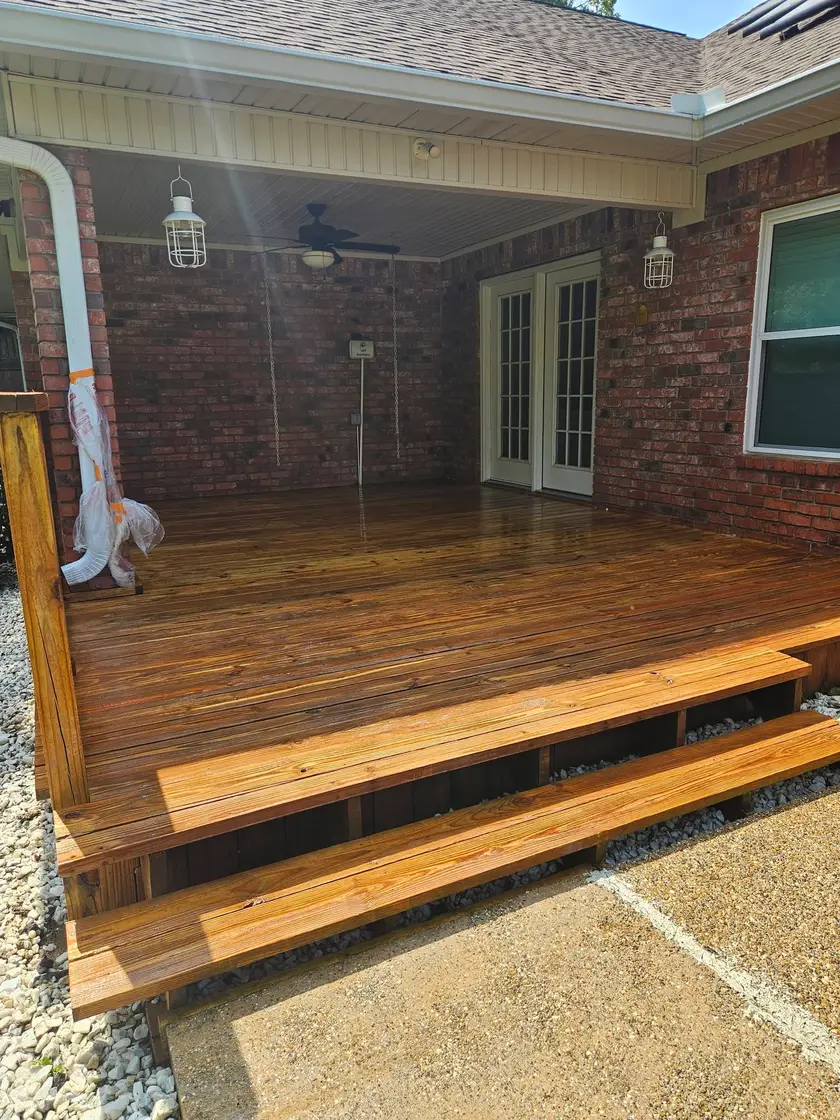
Weathered porch railing and skirting boards go gray where the old finish wore off, and gray on its own is just an old finish. Bare wood takes paint. Soft wood takes new boards. The difference is a thumb on the board, and you can do that part yourself in the time it takes to circle the house.
The ground beside the foundation shows you where the rain goes in a storm. A bare wash beside a house turns up where roof runoff cut a channel into the soil, and a downspout extension lying loose on the leaves dumps that water at the base of the wall. A soft spot underfoot at the bottom course points at water that never left. The paint is the outside layer, and everything that sets the size of the job is behind it.
Siding boards come down
We pulled the lap siding off one wall and laid the sections out on the grass. The rot was along the back of every board, and the painted face of those same boards was still holding paint. A lap board can keep its paint on the front and be gone on the back, and that is why a wall can look right from the driveway.
The back of a siding board never gets sun and it never gets wind. Water that slips behind the panel stays against bare wood in the dark. The front sheds that water and dries out by the afternoon. The back has no way to do either.
Siding panels fasten to the sheathing. House wrap goes between them and sheds the water that gets past a board. Behind the sheathing is the wall framing with the bottom plate at the base of it, and the band board is the piece that ties the floor frame to the wall. Water that gets that far collects at the bottom, so the bottom plate is where the damage turns up first.
On one wall around here, two bays of foil-faced insulating sheathing stood exposed once the siding came off, with rot along the bottom plate. Foil-faced board like that turns up under plenty of older siding in Garland County, and so does plain wood sheathing on a house of the same age. From the yard both of those walls look the same. That wall stopped being a guess the morning the panels came off it.
The wall goes two ways
Sound sheathing and new panels
The first road is a sound wall under the siding. One newer wall opened to bare OSB in the bay with the sheathing above it still exposed, and the wood was dry all the way down. House wrap goes over that, and the new panels go up over the wrap.
That wall closed in with new vertical groove panels painted cream, with a drop cloth still down on the grass. A second wall along a deck went back in vertical groove siding painted light gray, with the sill line masked before the paint went on. Both of those jobs went from the outside in, and neither one needed a saw put to the framing.
On a wall like that, the siding replacement cost covers the panels, the wrap, the trim and the paint. The soffit under the roofline and the fascia along the edge can ride along on the same ladders while they are up, which is why we quote siding and exterior work as one job. Nothing behind the sheathing gets touched, because nothing behind the sheathing was wet.
Rotted framing and grade work
The second road is the rot getting past the siding. The bottom plate gets cut back to sound wood before any new panel arrives on the house. One wall stripped back to foil-faced sheathing beside a brick chimney had the rotted band board cut out of it. New wood goes back in there before a single panel does.
Then comes the water that did it, because new wood put back in front of the same downspout goes the same way as the old wood. A gravel drainage run laid the length of a house gets graded so roof water goes away from the foundation, and we lay that gravel and drainage on the same visit. Beside another house, bare dirt and leaf litter came back as washed river gravel graded out to the fence line.
The new panels go on once the ground stops carrying water toward the wall. Two houses of the same age with the same siding on them can end up here, and the two jobs have almost nothing in common past the first morning. One is panels and paint. The other is framing, a band board and a day of grading before a single panel goes up.
What you settle first
You settle the look of the wall before anybody quotes it. You pick the panel type and the profile of the board. Cream and light gray have both gone up on walls around Garland County, and the color is yours. So is whether the soffit and the fascia get done while the crew is already on the ladders.
Nobody settles the rest until the wall is open. The sheathing behind the panel, the bottom plate under it and the band board tying the floor to the wall are all out of sight until the siding comes down. A phone call cannot get at any of them, and neither can a photograph you send us of the outside of the house.
So the number we write comes off a wall somebody has inspected, and it holds unless you change the scope. That is the honest half of the answer to what a siding job costs in Hot Springs Village or anywhere else around here.
The day the panels come off is the day the wall stops being two possible jobs and becomes one. Somebody has to be standing at that wall when it happens, and that is what the visit is for. Look at siding jobs we have finished, or call 501-276-4770 and we come read your wall.
Every job on this site was finished by the same crew around Hot Springs and Hot Springs Village. Read more about exterior updates, look at the finished work, or ask us about your own house.